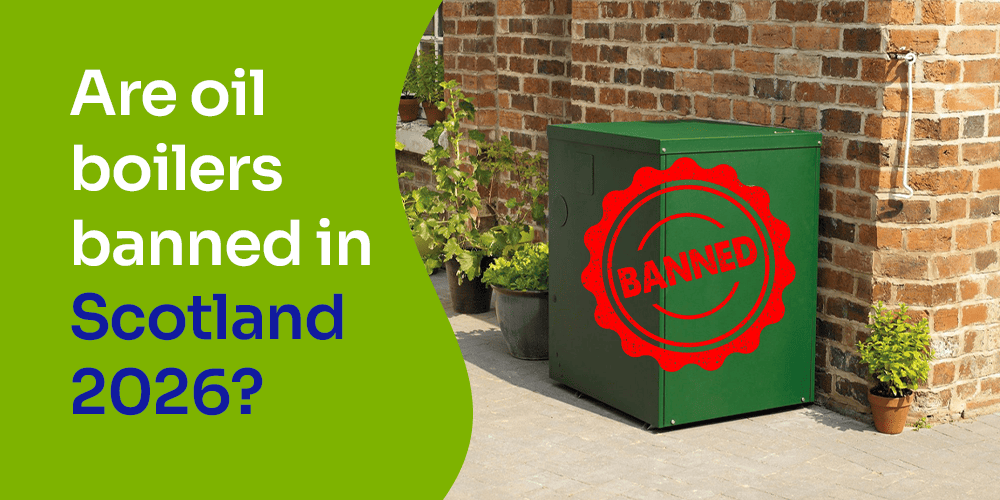
A lot of the Scottish homeowners are wondering if the oil boilers are being banned in Scotland in 2026. Many are even thinking they would have to rip off their heating system completely just because it is not a modern one, which is definitely not true.
The reality is the government wants to replace oil boilers all over Scotland, but they won’t be banning them completely in 2026. The process to accomplish this goal is not quite simple. The government across the UK wants to achieve net zero carbon emission by 2045. To accomplish this goal, they have initiated several government free boiler grants to help families in the UK to use low-carbon-emitting boilers while staying warm throughout the whole winter season.
But the UK government’s plan to replace old and outdated boilers doesn’t make your oil boilers illegal, as many homeowners who are private tenants in Scotland are assuming.
The oil boiler replacement scheme doesn’t mean that your oil boiler is against the law or that you need to get a new one right away. The government does want households to switch to cleaner, low-carbon heating options like heat pumps, biomass boilers, and hybrid systems, though. Several grant programmes across the UK support this.
Why Are Oil Boilers Being Phased Out in Scotland?
Scotland aims to encourage homeowners to switch to alternatives like renewable or electric systems to achieve their goal of:
- Reduce greenhouse gas emissions in the whole country and reach its goal of net-zero by 2045.
- Help individuals use more efficient heating systems like heat pumps and biomass boilers to lower the cost of energy bills.
- Homes that last longer and have cleaner heating systems.
In short, shifting towards alternatives to replace oil boilers doesn’t seem to be as much about harming people as it aims to make Scotland’s heating future more sustainable and affordable for everyone.
Low-Carbon Alternatives for Oil Boiler Replacement
To replace your old, inefficient boiler, you have several good boiler replacement options that are also supported under the government’s free boiler replacement scheme.
Air Source Heat Pumps (ASHPs)
Air source heat pumps are eco-friendly heating systems that circulate heat from the outside air into your home, even when it’s extremely cool outside.
Ground Source Heat Pumps (GSHPs)
These types of heat pumps have pipes buried under the ground surface. They provide heat through a network of wires that are spread across the home. Having underground wires makes them have stable temperatures throughout the year. They are most ideal for rural homes or properties that have enough space for outdoor installation.
Biomass Boilers
Biomass boilers are also traditional, but they are thought to be a renewable heating solution, as they use organic material such as wooden pellets or chips instead of fossil fuels.
Electric Heating Systems
Panel heaters or modern-day storage heaters are the most commonly used electric heater types nowadays. They directly convert electricity into heat; hence, they don’t require any kind of fossil fuel to provide heat. Although they are comparatively more expensive to run in the long term.
Hybrid Heating Systems
They are made of the combination of a back boiler and a renewable heat pump. It has an automatic switch which helps the system to provide you with the best use of both of these boiler kinds. They are the most flexible option to reduce emissions and lower your energy bills.
ECO4 Scheme Eligibility
“100% Free Check – No Hidden Fees”
Government Grants for Oil Boiler Replacement
There are several government grants and funding programmes to help UK homeowners cover for oil boiler replacement. Some of these grants are mentioned below:
ECO4 Scheme Features:
- The ECO4 scheme offers full government funding to qualifying families.
- Allows you to transition to any kind of heating system.
- Offers extra insulation and repair that can save energy.
- Most boiler companies offer extended warranties and aftercare.
- Gas Safe engineers check and keep track of everything during the process.
Key Features of BUS Grant:
- Can offer a £7,500 grant for the installation of modern boilers like the air source heat pump.
- It is available for all homeowners, landlords, and private tenants.
- It can provide grants for systems up to 45 kWth capacity.
- There is no income requirement or means evaluation for eligibility.
- Applicants must use MCS-certified installers for checking eligibility.
- It is mainly to replace fossil fuel heating systems such as oil-fired boilers.
Other Regional Grants for Oil Boiler Replacement
Government funding for free boiler replacement is available in various areas across the UK, such as England, Scotland, Wales and Northern Ireland.
- England: The Boiler Upgrade Scheme and ECO4 scheme are the main sources of funding in England.
- Wales: There are several community-based grants available in Wales to help people save more on their energy bills.
- Northern Ireland: Local government schemes offer extra support in rural and off-grid regions to help the people of Northern Ireland.
Who can qualify?
The ECO4 Scheme aims to help UK families to use less energy, burn less carbon, and save money on their heating bills. If you fall under any of these categories, you might be able to receive a free oil boiler replacement grant:
1. Income & Benefits Criteria
If you receive any of the following benefits, you may be able to qualify for air source heat pump grants too:
- Universal Credit
- Pension Credit
- Income Support
- Employment & Support Allowance (ESA)
- Jobseeker’s Allowance (JSA)
- Child Tax Credit
- Working Tax Credit
2. Household & Property Criteria
You might be able to qualify for funding even if you don’t get benefits if:
- Your house has an EPC rating of D, E, F, or G (we can check this for you).
- Your total household income is less than £31,000 annually.
- You’re part of any of these groups:
- Elderly
- Disabled
- families with young children
- Your home currently uses expensive heating methods such as electric, LPG, oil, or solid fuel.
3. ECO4 Route 3: Medical Referrals
Your doctor or the NHS Trust can refer you to this route of qualification if you have any of the following conditions:
- Cardiovascular disease
- Respiratory issues (e.g., asthma, COPD)
- Limited mobility or chronic illness
- Immunosuppressed conditions
How to apply:
- Get a quote from accredited installers like CO2 Reduction.
- Your chosen installer will submit the application to the government body Ofgem on your behalf.
- If you qualify, the government grant will be initially given to the installer, and then they will provide you free-of-cost service.
Implications for Off-Grid Homeowners
For off-grid households, transitioning to cleaner heating can mean considering a few practical things:
Installing an air or ground source heat pump that utilises renewable energy to heat your home but could require better insulation and enough outdoor space.
Installing a biomass boiler which burns wood chips or pellets. It operates best for rural homes, but it needs an isolated location for storing fuel and regular maintenance.
Adding solar thermal panels as an additional source of heat can help cut down on the amount of fuel and energy used in general.
The actual cost of these modern heating systems might be higher, but government-backed programmes like the ECO4 scheme and the Boiler Upgrade Scheme can help qualifying households cover these expenses.
FAQs
Are oil boilers being phased out in Scotland?
Most certainly, yes. As part of the UK’s net zero carbon goal, it is being recommended that new homes should not install oil boilers.
Are oil boilers being banned in the UK?
No, this is not completely true. Limitations on construction are scheduled for 2035; however, there won’t be a complete ban on oil boilers in the UK in coming years.
Will I have to replace my gas boiler in 2025?
No. Gas boilers can still be in use. Currently, only newly constructed buildings in Scotland are being told to not install outdated gas boilers.
What is the future of boilers in the UK?
Heat pumps and biomass are the new green alternatives that will replace old inefficient boilers within the mid-2030s and 2045.