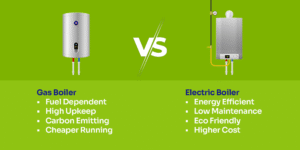

Every newly built home needs to meet the UK’s Future Homes Standard. By 2026 the ban will prohibit the installation of oil boilers only in new buildings, while the full ban will take place in 2035. This will be a cultural change, as we will be moving towards cleaner, more efficient home heating.
As the government intends to cut the household heat emission, along with reducing the energy cost and protecting the environment, they have started working on a decade-long plan. In 2026, the enforcement of the Future Homes Standard is coming into effect. By 2026, no new oil boiler will be installed or sold. And by 2035, there will be a complete ban on the installation of oil boilers in all areas of England, Wales, and Northern Ireland.
Why Are Oil Boilers Being Phased Out?
The UK’s push to reach net-zero emissions has caused the ban of oil boilers, as they emit carbon dioxide. Oil boilers are one of the biggest environmental polluters, emitting 4 to 6 tonnes of CO₂ per household. This ban is similar to the gas boiler ban, which prohibits new homes from installing gas boilers from 2026 onwards. Unfortunately, oil boilers emit twice as much CO₂ as gas boilers.
Government Regulations and Policies
Around 1.5 million houses in the UK rely on oil boilers; banning them on a country scale can be stressful for the citizens, as in the future these households will no longer get a chance to replace or get a new boiler. This transition can cost between £6,000 and £18,000, which may be extremely costly for most users. But there is not much to worry about, as the government has granted UK citizens a scheme to replace their old and inefficient oil boilers for completely free.
At CO2 Reduction, we work with the ECO4 scheme to help households replace old and inefficient oil boilers with brand-new, energy-efficient systems that are also completely free of cost.
ECO4 Scheme Eligibility
“100% Free Check – No Hidden Fees”
Are there any alternatives for oil boilers?
As time passes, the world is moving towards more eco-friendly resources, which will make boilers using fossil fuels like oil and gas a thing of the past. Moving to eco boilers can be really helpful for the environment. Let’s explore some of the alternatives for oil boilers:
Biomass Boilers
Like other industrial boilers, biomass boilers are a system that generates heat and energy. But, instead of consuming natural gas, coal, or other fossil fuels, biomass boilers generate energy through biomass combustion.
How does a biomass boiler work?
Biomass boilers burn highly sustainable, carbon-neutral, and renewable fuels in the form of wood. This may feel like a fairly old-fashioned way of generating heat, but it’s one of the most reliable. So if you’re seeking a renewable alternative to fossil fuels, then a biomass boiler could be a suitable option.
There are numerous sources of biomass fuel, including:
- Wood (logs, pellets, chips, sawdust, and lumber waste)
- Agricultural products (corn, soybeans, sugar cane, and more)
- Paper
- Cotton
- Wool
Animal manure and human sewage
Each type of biomass has unique pros and cons related to its use. Wood chips are often a popular choice because of their low cost compared to other fuel options. However, wood chips are also less efficient than other fuels like wood pellets, whose dense composition allows them to burn longer and release more energy.
Industrial biomass boilers can be customised to fit the needs of each specific industry and application, with options ranging from:
Fully automated industrial biomass boilers
- Semi-automated industrial biomass boilers, also known as surge bins, are available.
- Pellet-fired industrial biomass boilers
- Agricultural pellet system industrial biomass boilers
- Combined heat and power industrial biomass boilers
The benefits of fully automated boilers remove most of the upkeep and maintenance necessary to keep the system running, like ash removal, and eliminate costly downtime.
This system is supported by the Boiler Upgrade Scheme (BUS). This system can also be installed alongside old, inefficient oil boilers.
Air source heat pump (ASHP)
A heat pump that uses air looks similar to air conditioning units. It absorbs the heat from the outside air and uses that to increase the temperature inside the home. Its size decides how much heat they need to generate for the house. A bigger pump means more heat.
There are two main types of heat pumps that use air as a source:
I. Air-to-water
II. Air-to-air
They work in different ways and are compatible with different types of heating systems.
Air-to-water heat pumps
They’re most suitable for homes with larger radiators or underfloor water heating because the heat they produce is cooler than that from a conventional gas or oil boiler. To be most effective, they need a large surface area to release the heat.
Air-to-air heat pumps
Air-to-air heat pumps are an alternative to other types of electric heating and could be a beneficial choice for flats where an air-to-water system is not feasible or where you hope to heat a small space. to heat a small space. to heat a small space. Toto heats a small space. The government also supports these systems.
Ground Source Heat Pumps (GSHP)
A ground source heat pump is a heating/cooling system for buildings that uses a type of heat pump to transfer heat to or from the ground, taking advantage of the relative constancy of temperatures of the earth through the seasons. These systems offer high efficiency, low operating expenses, and reduced carbon emissions compared to traditional heating methods.
How do ground source heat pumps work?
It starts with a loop of pipe that’s buried in your garden or outdoor space. This loop could either be a long or coiled pipe buried in trenches or a long loop inserted into a borehole. Inside this pipe is a mixture of water and antifreeze called a thermal transfer fluid (TTF), sometimes known as brine.
The brine absorbs heat from the ground, which then passes through a heat exchanger into a refrigerant. The refrigerant is compressed, raising its temperature, and this heat is transferred again to your central heating system.
Benefits of ground source heat pumps
- Compared to other heating sources, this is one of the cheapest.
- Heat pumps are a low-carbon heating system, emitting fewer CO₂ emissions than other fuel sources.
- It reduces the energy use, as for every unit of electricity they use, heat pumps generate three units of heat.
Installation Cost of Ground Source Heat Pumps (GSHP)
Installation of these heat pumps typically costs up to £30,000, which can be extremely costly for common folks. However, the government has provided us with a scheme to cover up this cost, called the boiler upgrade system.
Hybrid Heating Systems
It comes to life as a combination of boilers and heat pumps. Basically, it involves a combination of two or more ways to generate heat to keep the house warm.
Types of hybrid heating systems
There are several ways to make a hybrid system. Such as:
- A gas or oil boiler with a ground-source heat pump
- A gas or oil boiler with an air-source heat pump
- A gas or oil boiler with a collection of solar panels
The low billing cost and lower CO₂ emissions are only two of the many benefits of a hybrid heating system.
Solar Thermal Heating
Solar thermal systems use the sun’s natural energy to heat water for your home. This environmentally friendly technology can help you consume fewer fossil fuels. Solar thermal solely is unable to replace oil boilers, but if combined with heat pumps or biomass boilers, it can reduce carbon emissions and energy costs significantly.
Benefits of Switching to the Alternatives
The UK government is working to stop the installation of oil boilers in 2026, so homeowners should look into alternative eco-friendly options like air source heat pumps, ground source heat pumps, and biomass boilers. Not only does upgrading your heating system help you follow the rules set by the government, but it also lowers the amount of carbon your home releases. New energy-efficient systems cost less to run and make your home more comfortable. Also, government free boiler programmes like ECO4 make these improvements less costly.
Conclusion
More economical and environmentally friendly heating systems will replace oil boilers by 2026. Your new boilers may be entirely free with the ECO4 initiative, so you don’t have to worry about paying for installation.
At CO2 Reduction, we assist households nationwide in taking advantage of the environmentally friendly and more affordable ECO4 funding.
FAQs
Will oil boilers be phased out after 2026?
As part of the UK’s commitment to reducing carbon emissions, oil boilers will most likely be phased out after 2026.
Are oil boilers allowed in new homes in 2026?
From 2026 on, any newly constructed home must meet the Future Homes Standard, which effectively prohibits oil boilers in new developments.
Should I replace my oil boiler?
If your oil boiler is old or inefficient, it may be a good idea to replace it with a more modern, eco-friendly system.
What will replace gas boilers by 2035?
The installation of new gas boilers will stop by 2035. Instead, low-carbon heating systems will take their place.
Should gas boilers be replaced in new homes by 2026?
As per the government advisor statement: “If the UK is to reduce its CO₂ output to ‘net zero’, a total end to the installation of new fossil-fuelled boilers in any home should be brought in by 2035.”