As the energy prices are going up with each day, people are becoming more concerned about keeping their homes warm during the winter season; everyone is looking for ways to make their homes use less energy. Loft insulation is one of the smartest and cheapest improvements you can make. The UK government has helped a lot of consumers in the UK pay for these installation upgrades.
This article gives an in-depth summary of everything you should know about the loft insulation grants, from eligibility criteria to government programmes, and its step-by-step application guidelines on how to apply for a grant.
Differences Between the ECO4 Scheme and the Great British Insulation Scheme (GBIS)
The ECO4 scheme and the Great British Insulation Scheme (GBIS) are the two primary government-backed programmes that are initiated to help low-income and vulnerable households. These government grants aspire to make homes in the UK use less energy, but they all are aimed at different categories of people and have different requirements for anyone who wishes to join. The first thing you need to do to pick an ideal loft insulation grant for you is to understand the differences between each of them.
The Energy Company Obligation (ECO4 Scheme)
The ECO4 scheme is the UK’s biggest programme that assists low-income households to save on energy bills. This scheme began in April 2022 and will end in March 2026. The ECO4 scheme aims to improve the least energy-efficient homes by helping them upgrade their heating systems.
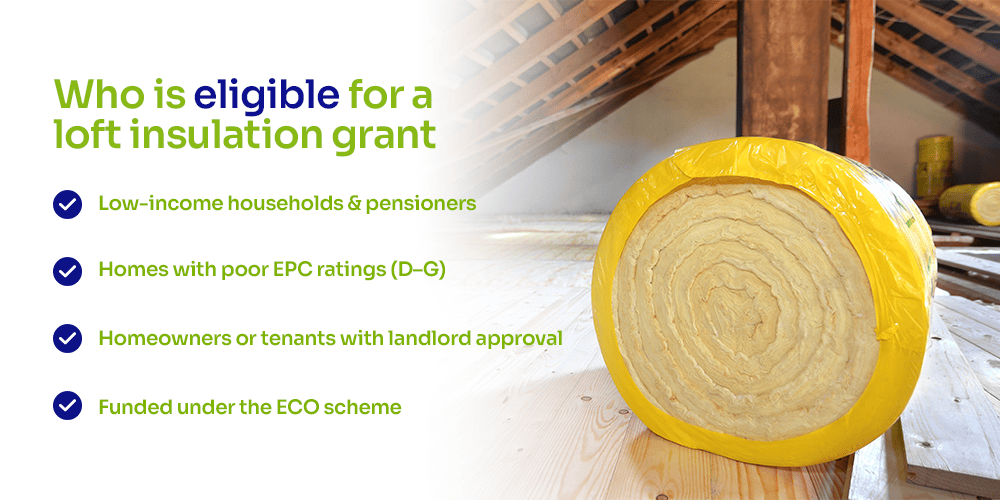
ECO4 Scheme Loft Insulation Grant Eligibility: Who Can Apply
One of the major purposes of the ECO4 scheme is to support houses that are facing fuel poverty and have low income. To qualify, a household must get at least one of these listed means-tested benefits. You may be able to get a loft insulation grant if you or someone in your family gets any of the following:
- Child Tax Credit
- Working Tax Credit
- Pension Credit (Guarantee or Savings Credit)
- Income-based Jobseeker’s Allowance (JSA)
- Income Support
- Universal Credit
- Housing Benefit
- Income-related Employment and Support Allowance (ESA)
These are the most up-to-date and widely accepted rules for benefits, but it’s crucial to remember that they can evolve over time.
ECO4 Scheme Eligibility
“100% Free Check – No Hidden Fees”
ECO Flex: Local Authority Route to Loft Insulation Grant Eligibility
If you don’t get the listed benefits, you can still be eligible for the famous ECO Flex scheme, also known as Local Authority Flex. Eligibility criteria for this scheme are comparatively more flexible than other government schemes. To become eligible for ECO Flex loft insulation grants, your local council can refer you for these grants if you meet some of these specific requirements, like:
Low income: If your family’s yearly income is less than a particular amount, usually between £31,000 and £36,000 depending on where you live, you have a low household income.
Health Condition: If one of the family members has a medical condition that can get worse due to cold homes, including breathing problems or long-term illness.
High Energy Bills: This is for you if you run out of gasoline or consume a lot of energy.
This flexible approach will help more low-income and vulnerable families obtain the care they need, even if they don’t get regular benefits.
The Great British Insulation Scheme (GBIS)
The Great British Insulation Scheme, which used to be named ECO+, is a newer scheme that runs alongside ECO4 until March 2026. The goal of this program is to aid more people who may not qualify for ECO4 and give them greater help. The primary distinction is that GBIS doesn’t try to make entire homes better; it merely gives each household one cheap way to insulate. This is supposed to help millions of homes save money and energy very quickly.
Eligibility Criteria for the GBIS Loft Insulation Grant
As compared to the ECO4 scheme, the GBIS offers a simpler application process, which makes it widely accessible for the general audience. There are two methods to qualify for the Great British Insulation Scheme: as a general group or as a low-income group.
Low-Income Group: This group is for those people who don’t make much annually and get benefits as mentioned in the ECO4 eligibility criteria. Given below can fall under this group:
- Energy Performance Certificate: Both homeowners and private renters who have an EPC rating below E for renters or below D for homeowners.
- Benefits: Residents receiving a means-tested benefit (such as the Universal Credit or Pension Credit, etc.).
- Low-income: Households that have a gross income under £31,000.
General Group:
People who don’t get any other benefits are still able to get the GBIS grant. Your home, not your wealth, determines what this group needs. Individuals with disabilities can also qualify for free loft insulation-based disability support from the government or a medical diagnosis suggesting that an uninsulated home may worsen their health and wellbeing. To meet the following standards, a household should:
- Health Condition: Have a family member diagnosed with a health condition that can get worse in the cold.
- Old Age: Home with a child under the age of 5 or a resident over the age of 65.
- Council Tax Band: Your residence must be in one of the Council Tax bands.
- English Bands A–D
- Scottish and Welsh bands A–E
Property-related eligibility
Every property has its own issues to tackle; for this unique situation, property-related eligibility is initiated. Your home must meet certain requirements in order to get a loft insulation grant. A professional surveyor will check these property-related requirement criteria physically.
Current condition of insulation
To get a loft insulation grant, your loft must either not have any insulation or not have enough insulation, which is usually less than 100 mm (approximately 4 inches). You should be able to view the tops of your ceiling joists. This suggests that your loft probably needs more space.
The Energy Performance Certificate (EPC)
The Energy Performance Certificate (EPC) shows how energy efficient your home is on a scale from A (most energy efficient) to G (least energy efficient). The purpose of GBIS and ECO4 is to help households with EPC scores of D, E, F, or G. Insulation on these things will stop most of the heat loss and save energy.
Loft Condition Requirements for Insulation Eligibility
You can only get a grant if your loft meets these conditions:
- There needs to be a clear, safe path for installers to get to the loft, as well as a hatch that they can open.
- There can’t be any concerns with building regulation authorities of the specific region. If the structure has decay, water, or other problems, the insulation may not work well.
- A professional should be able to work safely in the loft, so there should be enough headroom.
The only way to be sure of these rules and get an accurate estimate of the work that needs to be done is to have a competent professional undertake a free, no-obligation survey.
Alternative Loft Insulation Grants Available in the UK
Home Upgrade Grant (HUG)
The Home Upgrade Grant allows households in England who don’t have a gas supply and don’t have a lot of money to make their houses warmer and consume less energy. It offers insulation for the loft, walls, and low-carbon heating. This grant can help you save a lot of money on your energy bills and make your home more comfortable.
Warm Homes Fund
The Warm Homes Fund was established to help housing associations and local governments fight fuel poverty. It provides for extra insulation, like loft insulation, and heating systems that function better. It generally supports families that have low incomes or who live in cold or remote areas and are in danger.
Nest Scheme (Wales)
The Nest Scheme provides certain households in Wales free upgrade services like loft insulation and new boilers to help them in making their homes more energy efficient. Its main goals are to minimise carbon emissions and the cost of heating. The Welsh Government pays for a Nest Scheme to help individuals who are having difficulties with their energy expenses.
Warm Homes Scotland
People who own or rent homes in Scotland may receive grants from Warm Homes Scotland to make their heating and insulation better. Insulating your loft is one of the best improvements you can make with the Warm Homes Scotland scheme. It helps keep homes warmer and saves money on heating bills for people who cannot afford high bills.
Why Act Now?
The chance that needs to be acted on right away
The ECO4 and the Great British Insulation Scheme will both cease in March 2026. There is no assurance, but the plans might be put off. Landlords need to act swiftly on this chance.
First-Come, First-Served: Installer appointments fill up quickly, and the money for these programs goes to the people who show up first.
Save as much money as you can: insulating your attic could help you cut down on your energy bills by a lot.
Increase the Value of Your Property: A property that is effectively sealed and uses less energy is usually worth more and gets more renters and buyers.
How to Apply for a Free Loft Insulation Grant
If you know what to do, the entrance process should be easy and straightforward. Here are six simple steps to get started:
Check Your Eligibility: The first thing you should do is use an online tool to see if you qualify, like the one on our website. This simple check will show you right away if you meet the first requirements.
Talk to a certified installer: You should talk to a certified installer as soon as you know if you are eligible. Companies like CO2 Reduction know how to assist people in getting the most out of these incentive programs and work with qualified installers.
Free Survey: You don’t have to pay for an official inspector to come to your house if you get a free home survey. They will check your loft to make sure you can choose the finest insulation option.
Filling out an application: The provider will take care of all the paperwork and apply for the grant for you.
Setting up: After your application is approved, you will be given time to set up IT. The process goes quickly and doesn’t cause any complications. It normally takes just a few hours.
Enjoy Your Savings: You may start enjoying a warmer house and lower energy bills as soon as the work is done.
Conclusion:
In times when every penny matters, a free loft insulation grant is too good to pass. The result is the same whether you qualify for the ECO4 plan or the Great British Insulation plan: a warmer, more energy-efficient home and high savings on your home’s energy bills. Find out now if you are ready to make your home more energy efficient. With just one call or click, you could get a free update that will help you for years to come.
Do not hesitate to call our experts today for a free session. You can also check out to see if you are eligible.
FAQs
How can we differentiate the Great British Insulation Scheme (GBIS) loft insulation grant from the ECO4?
The GBIS programme helps more groups of people than just those who get benefits. Whereas the ECO4 programme is largely for families who get listed benefits and have a low-income approach.
How can I find out if my family can get a grant based on the benefits?
If you or someone in your family gets benefits like Housing Benefit, Universal Credit, Income Support, or Pension Credit, you can be qualified to get an ECO4 scheme.
Do I need to meet any requirements to get a grant for loft insulation?
Yes, you either need to have a loft that doesn’t have any insulation at all or has less than 100 mm of insulation. Also, your home needs to have an EPC grade of D, E, F, or G.
What do I need to do to get a free loft insulation grant?
If you call an approved installer like CO2 Reduction, they will provide you a free qualification check and a home survey with no upfront cost.
What other kind of upgrade can these grants be used for besides loft insulation?
Many of these government grants can also be used to pay for things like heat pumps, boiler replacement, or adding insulation to the walls, either solid or cavity.